
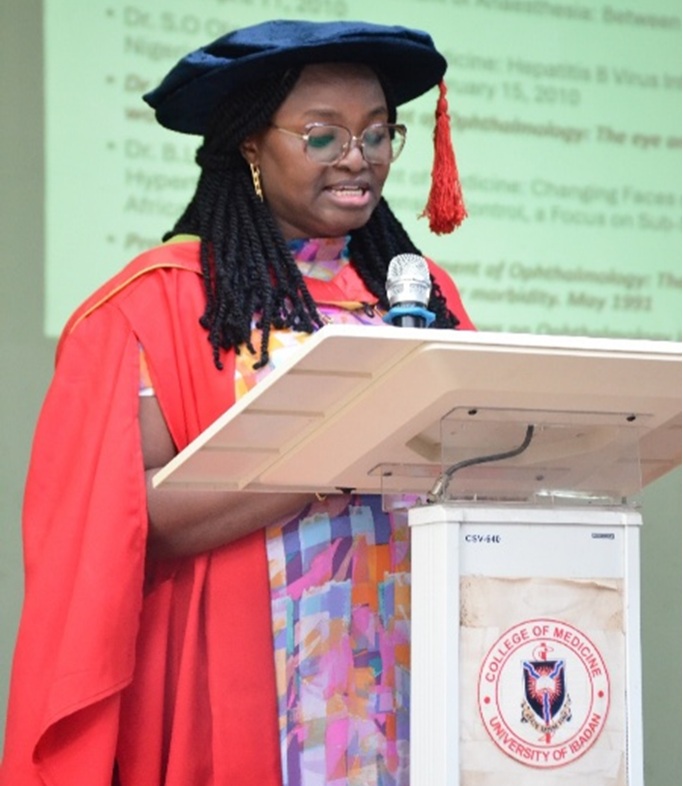
The Principal Investigator of the Point of Screening Ocular Tuberculosis Project (POS-Oc TB), Dr. Yewande O. Babalola of the Department of Ophthalmology, College of Medicine, University of Ibadan (CoMUI) has revealed that timely detection of ocular tuberculosis through screening is key to preventing vision impairment and loss.
Dr. Yewande O. Babalola made the disclosure while delivering the Faculty of Clinical Sciences Lecture titled “Ocular Tuberculosis: Seeing the Unseen Through the Looking Glass’’ on Wednesday, 16th September 2026, at the Paul Hendrickse Hall, College of Medicine, University of Ibadan.

The lecture, the fifth from the Department of Ophthalmology since 1991 which addressed ocular tuberculosis and its public health implications, forms part of the university's academic tradition of showcasing research work to the wider community within and beyond the institution.
While emphasising the need for greater awareness of the disease among health workers, Dr. Babalola said not even one in over 5000 patients with tuberculosis knows that tuberculosis could affect the eye.
She explained that ocular tuberculosis may occur when mycobacterium tuberculosis, (the causative agent of tuberculosis (TB), spreads through the blood stream from another infected part of the body to the eye and could affect the various areas of the latter.

Dr. Babalola, who is a senior lecturer in the department of ophthalmology pointed out that ocular TB may occur without obvious symptoms but when it does, the clinical presentations and manifestations may include blurred or reduced vision, redness, pain in the eye, sensitivity to light, floaters or spots in the field of vision and swelling or inflammation of the eye.
The lecturer also identified cigarette smoking, close or prolonged contact with TB patients, a weakened immune system and areas where TB is prevalent as risk factors that may increase the chances of contracting the disease. Dr. Babalola drew attention to the significant burden of tuberculosis in Nigeria, noting that the country is one of the high burden countries which all account to up to two-thirds of all global cases of tuberculosis, and highlighted that her research revealed a prevalence of ocular tuberculosis nearly double of that found in a study in Nigeria conducted two decades earlier.
In his opening address, the Provost of the College of Medicine, Professor T. O. Ogundiran, emphasised the importance of the academic tradition, stating, "This is an academic tradition of the university that is very important for our academics to showcase what they have been working on and to disclose this to the wider community within and beyond the university."

The event attracted distinguished dignitaries including Professor T. A. Lawal, Dean of the Faculty of Clinical Sciences, (who read the lecturer's impressive citation), as well as past and present members of the College of Medicine management, heads of departments, sub-deans, consultants, residents, and medical students.

Key highlights of the lecture included the presentation of the “Preventing debilitating blindness by screening for ocular manifestations and ocular side-effects of anti-tuberculous therapy in patients with pulmonary and extrapulmonary tuberculous” (POS-OcTB) which Dr. Babalola leads as principal investigator, focusing on preventing blindness through screening for ocular manifestations of tuberculosis and creating awareness amongst all categories of health workers. The project has conducted training workshops across multiple departments including Medicine, Paediatrics, and the Infectious Diseases Institute (IDI). Preliminary data from screening patients with tuberculosis revealed that approximately one-fifth had ocular involvement. She also presented compelling case studies, including a 33-year-old patient whose asymptomatic ocular lesions were discovered despite normal vision, underscoring the importance of routine eye examinations in this group of patients.

The lecture holds significant implications for public health policy in Nigeria, with Dr. Babalola recommending that perhaps all patients with a diagnosis of tuberculosis undergo eye examinations and continued education of health workers to raise awareness about the ocular manifestations of the disease. The lecture was concluded with acknowledgements of collaborators including Stanford Medicine, Stanford Centre for Innovation in Global Health and Pfizer whose Global Health Fellowship supported the research. The lecturer's citation noted her selection for the 2026 Cohort of the WomenLift Health leadership journey for women leaders in Global Health—a recognition that positions the University of Ibadan as a contributor to international medical scholarship and research excellence.
The Dean, Faculty of Clinical Sciences, Professor Lawal at the post-lecture cocktail held at the AOK Johnson Boardroom afterward presented a commemorative plaque to Dr. Babalola in recognition of her lucid and insightful presentation.
By: Biomedical Communication Centre (BCC, CoMUI)